OpenAI has expanded its Daybreak cybersecurity program with the introduction of GPT-5.6-Cyber, a purpose-trained model specifically designed for authorized vulnerability research, exploit validation, and advanced security testing. Built on the foundation of GPT-5.6 Sol, this new model serves as a controlled-access tool for trusted defenders as AI-assisted offensive capabilities continue to evolve. GPT-5.6-Cyber to Find […]
Attackers shut down a steam turbine and the process-water treatment system at a Polish combined heat and power plant by coming in over the private cellular network the local grid operator uses to reach remote equipment.
The plant supplies heat to roughly 50,000 residents. Recovery began at about 7:30 a.m. while the intruders were still active inside the network, and customers lost neither heat
DeadLock, an emerging financially motivated ransomware operation that couples conventional intrusion tradecraft with decentralized infrastructure engineered to survive disruption. First observed in July 2025, the operation uses double extortion: encrypting enterprise data while threatening publication of stolen material. The encryptor’s pre-encryption routine is built to degrade both prevention and recovery. After XOR-decoding an embedded configuration, […]
Security researchers have recently revealed a new attack family named “Pass-the-Passkey,” which enables adversaries to impersonate enterprise users and circumvent phishing-resistant multi-factor authentication (MFA) protections in Windows 11 and Microsoft Entra ID environments. This research challenges the belief that passkeys are inherently immune to credential replay and session abuse. Pass-the-Passkey Attack Exploits Windows The attack […]
Cybersecurity researchers have warned of a supply chain compromise impacting WordPress plugin vendor BdThemes, prompting the content management systems (CMS) platform’s plugins team to temporarily disable their downloads.
“Unlike traditional software supply chain attacks, zero source code files were modified within the official WordPress.org repository,” Wordfence researcher Paolo Tresso said.
Abyssos, a modular C++ remote-access trojan that combines credential theft, browser-session hijacking, file exfiltration and hidden VNC control in a single post-compromise framework. Technical analysis from ThreatLabz indicates that Abyssos is designed for hands-on intrusion activity rather than opportunistic, single-purpose theft. The most concerning feature is its hidden VNC capability. The HVNC_START command opens a […]
Red Hat has disclosed a privilege-escalation vulnerability in Red Hat Advanced Cluster Management for Kubernetes (ACM) that could allow a low-privileged user to gain full cluster-admin control of an affected hub cluster. This vulnerability is tracked as CVE-2026-10090 and affects the Application Subscription controller, specifically the multicluster-operators-subscription. It has a CVSS v3.1 score of 9.9 […]
Anthropic will make Auto Mode the default setting in Claude Code for Pro, Max, and Team subscribers starting August 14, 2026. This change introduces an automated classifier to replace repetitive manual permission approvals during long-running development tasks. The goal is to reduce “permission fatigue,” a condition where developers approve prompts without thoroughly examining the associated […]
CISA and international law-enforcement partners have issued a joint #StopRansomware advisory warning that Gunra ransomware affiliates are exploiting exposed edge infrastructure, including VPN gateways, firewall appliances and RDP-accessible systems, to breach enterprise networks. The advisory positions Gunra as an increasingly organized ransomware-as-a-service operation whose affiliates combine data theft, credential compromise and rapid encryption to pressure […]
The start of the 2027 fiscal year is less than two months away, and in typical fashion, the annual defense budget is in limbo. Three out of Congress' four defense committees have released markups that adhere to the Trump administration’s $1.1 trillion topline request. None has addressed the White House's proposal to spend another $350 billion through the unusual use of reconciliation funding, though discussions are underway for a smaller reconciliation package that could include money sought in a supplemental request for operations in Iran and other priorities.
The administration's decision to seek funding for many of its top priorities through the reconciliation process—until last year, it had never been used for defense appropriations—creates a "terrible risk," as Sen. Susan Collins, R-Maine, put it earlier this year. Congressional resistance to the idea of using novel funding mechanisms could mean steep year-over-year funding drops for various programs.
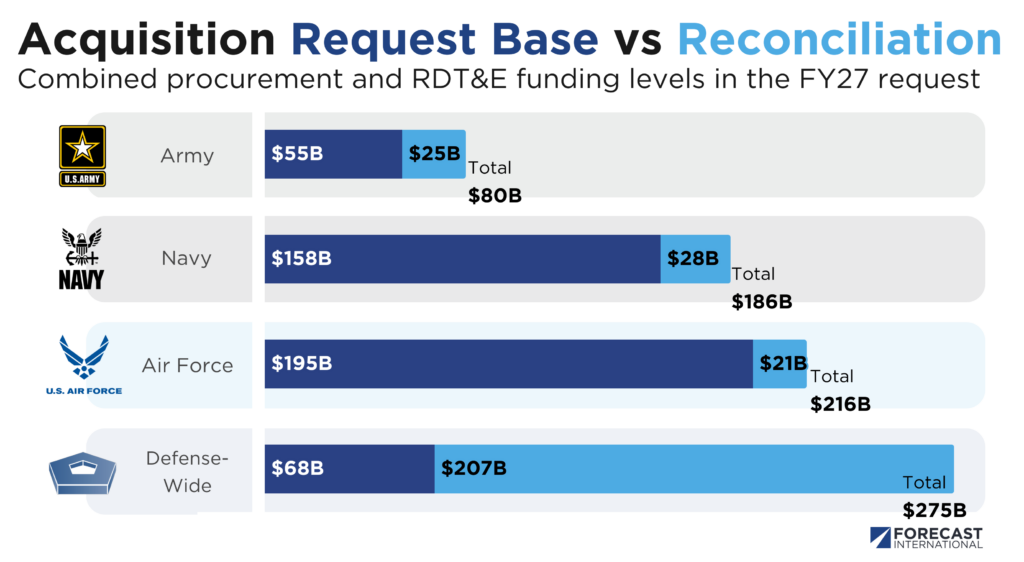
Per Forecast International's U.S. Defense Budget Spotlight dashboard, the biggest drops would be seen in defense industrial base and equipment investments contained in the Defense-Wide accounts, such as:
$54.6 billion for the Defense Autonomous Warfare Group
$40.6 billion for Industrial Base Analysis and Sustainment
$30.5 billion for equipment funded through the Office of the Secretary of Defense
$30 billion for Defense Production Act purchases
$20 billion for the Office of Strategic Capital Loan Program
$17.1 billion for the Golden Dome missile defense initiative
Infographic by Jorge Morejon
The White House also sought to buy many munitions through reconciliation, a choice rendered fraught by the subsequent decision to launch the war on Iran and expend much of the Pentagon's stockpile. For example, the reconciliation portion of the request contained $10.9 billion for Patriot interceptors and $10.5 billion for Terminal High Altitude Area Defense (THAAD) interceptors. The administration also aims to use reconciliation to backfill other programs, such as the F-35, KC-130J, and several shipbuilding programs.
Acquisition adjustments
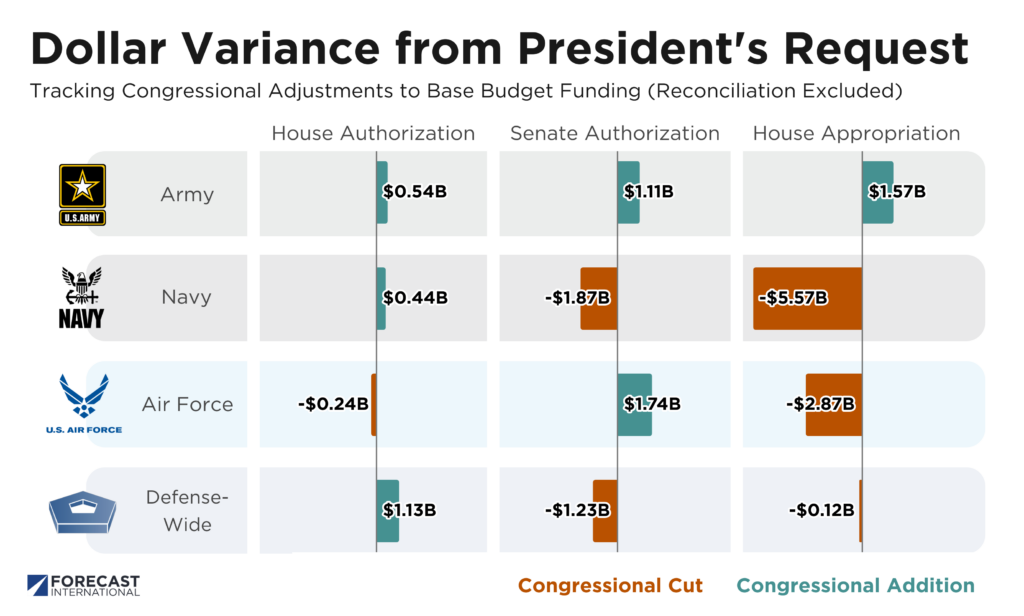
Dzens of programs across the services would see their funding adjusted under the legislation released by the House and Senate armed services committee and the House Appropriations Committee (HAC) legislation. The Senate Appropriations Committee has not released its markup. House appropriators recommended the biggest variance from the administration request: a $9.2 billion cut for procurement programs and a $2.2 billion plus-up for research, development, test and evaluation.
Discretionary research budgets came out ahead in all the defense bills so far: proposed increases of $2.2 billion by the HAC, $1.1 billion by the SASC, and $687.2 million by the HASC. All three committees recommended additional funding for Army and Navy research, to varying degrees, while the adjustments for the Air Force’s account were mixed. The HAC and SASC proposed to add $1.7 billion and $1.6 billion, respectively, while the HASC recommended a net reduction of $480.9 million. Meanwhile, every committee cut the Space Force’s research budget, from as little as $201.4 million by the HASC to as much as $3.1 billion by the HAC. Defense-Wide research was also cut by nearly $1 billion by the HAC and SASC, while the HASC proposed to add $558.1 million. The Air Force’s E-7, the Navy’s F/A-XX fighter, and unmanned surface vehicles (USVs) are poised to benefit from congressional adjustments, while efforts like the hypersonic Conventional Prompt Strike and the Space Force’s Automate Sat C2 effort may lose funds.
The graphic below shows total procurement and RDT&E funding adjustments by branch across the three defense bills that have been released so far.
Infographic by Jorge Morejon
On the procurement side, one of the standout performers is Army aviation, which did not benefit from the overall influx of money in the FY27 request. Despite the record size of the request, Army aviation funding declined in FY27 compared to FY26 levels and was $1 billion less than originally planned by the previous administration. Driven by ongoing transformation efforts, the request reduced funding for key programs, including the UH-60 Black Hawk and CH-47 Chinook. The HASC and HAC aimed to reverse some of those cuts, recommending increases of 27 percent and 47 percent, respectively, for Army aircraft procurement. However, the SASC recommended further reductions, trimming the service’s aircraft account by 7 percent. Following the initial release of the FY27 request, the Pentagon said it was open to revisiting its proposed aircraft reductions for the Army, and additional funding is expected to appear in the final version of the defense spending bill. Outyear spending plans may also be more favorable to Army aircraft.
The SASC pushed for a 12 percent increase in Air Force missile spending, a move the other committees did not match. That adjustment stems from an additional $845 million for the service’s Family of Affordable Mass Missiles (FAMM) program, which aims to field a range of new low-cost cruise missiles. House appropriators did recommend an extra $300 million for FAMM, which would offset a lack of reconciliation funding for the program. However, the committees reduced discretionary Army and Navy missile funding across the board.
The White House asked for a boost for Navy shipbuilding this year, but lawmakers demurred. The SASC and HAC proposed reducing the shipbuilding account by 5.1 percent and 5.8 percent, respectively. The SASC removed $1 billion requested for the BBG(X) battleship, as well as $2.4 billion for CVN refueling overhauls. The submarine tender program was also cut by up to half. House appropriators recommended stripping $1.4 billion for the service’s P-8A maritime patrol aircraft.
Topline with caveats
Even without reconciliation, all the budget proposals released by congressional defense committees so far sign off on a $1.1 trillion discretionary budget request, which is around $242 billion more than the FY26 base budget and $91 billion more than the total FY26 enacted level. The latter included around $152 billion from the initial reconciliation bill signed in July 2025. The result is that many of the appropriation accounts that faced discretionary cuts in the congressional markups are still funded at higher levels than in previous years, and the administration expects future base budgets to to exceed $1 trillion.
At the same time, the administration’s efforts to quickly increase production of munitions, drones, and missile defenses, among other priorities, may have to be tempered. Reconciliation requires only a simple majority in both chambers, several Republican lawmakers said they do not see enough support to pass a $350 billion reconciliation bill. Meanwhile, the defense industry is already struggling to keep up with growing demand.
The GOP has been working on a smaller reconciliation bill that includes $60 billion for the Pentagon. If adopted, that funding would primarily support initiatives contained in the Iran war supplemental request, particularly munitions replenishment. At the same time, the House and Senate have drafted continuing resolution proposals with the understanding that a final discretionary defense budget will not be passed until after the mid-term elections, meaning the FY27 budget process is far from over.